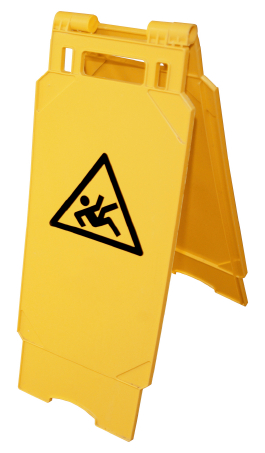
It happens all the time: A customer enters a store, hits a slippery spot, and takes a tumble. Some falls are minor, but many others result in serious injuries that lead to significant medical bills, lost work, rehabilitation, and considerable pain and suffering. Those hurt in this and similar ways often wonder if they have a legal claim to seek compensation for their losses.
In many cases the answer is “Yes.”
Slip and Fall Accidents
Most accidents in supermarkets, clothing stores, and other retail spaces are of the “slip and fall” variety. Potential legal accountability following these accidents is guided by an area of law known as “premise liability.” This refers to rules about what the owners and operators of a building are required to do to keep those on the property safe and secure. In general, owners must take “reasonable” steps to ensure the premises are safe for customers. When they fail to meet that duty, they can be held liable for the harm that results.
Negligent Store Owners
A personal injury lawyer can explain how negligence might be proven in your individual case. Many different factors may be involved depending on the exact way that you were hurt while in the store. Some of the most common examples of negligence include:
• Wet floors: When floors are mopped, customers should be warned that the space is slippery and presents a hazard. “Caution Wet Floor” signs should be used. Similarly, if there is a spill on the floor, the business must quickly clean the location to prevent unsuspecting customers from getting hurt.
• Insecure Shelving: Store shelves and items on the shelves should never fall onto a customer. Businesses must ensure shelves will not tip and that merchandise on the shelves does not tumble down.
• Rough floors/walkways: Uneven sidewalks, potholes, large entrance drops, loose rugs, and other hazards on the premises might present unreasonable dangers to those coming to the business. It is important for these establishments to take reasonable steps to eliminate these fall and injury risks.
Proving the Negligence
Any time that you are hurt while on business property you may be able to recover for your losses. A legal professional can explain the various parties who could be held liable for the harm suffered, including the store owner, a property manager, parent companies, and sometimes vendors or contractors working within the establishment.
In a potential legal case following the accident, it will be important to collect evidence that can help prove negligence on the part of the owner or operator. Evidence in these cases often includes pictures of the area where the accident took place or surveillance video footage of the actual fall. Statements from witnesses who saw the fall or the state of the store at the time of the incident are crucial. In addition, employee statements can be pivotal. For example, if a floor was wet, potential liability may hinge on whether or not an employee was near the area and saw it or had the chance to correct the problem.
Get Legal Help
No two cases are identical. At the end of the day, if you are hurt in any way while at a store, be sure to get in touch with a legal professional as soon as possible to share your story. The injury lawyer can explain how the law might apply, collect necessary evidence, and work on your behalf to ensure a timely, fair resolution to the legal matter.
Article By: William Dorsey Contact Us With Your Divorce Law Questions.
One of the most common fears of couples in divorce revolves around money. It is entirely reasonable for divorcing spouses to worry if they will be able to survive financially after the split. For one thing, many residents are terrified by the thought that they might find themselves paying their mortgage and marital debts alone.
However, following some simple measures provided by the law can ensure fairness in not only property allocation but also debt division.
The Basics
Marriage is like any other legally enforced agreement whose purpose is to create a union between two people. It results in a change of their status into husband and wife, giving rise to new rights and obligations to both spouses. The union is terminated by a demand for divorce, where the assets and liabilities are to be divided between the parties.
The law in Florida distinguishes marital assets and liabilities from non-marital assets and liabilities. When two people are married there is a presumption that all their property and debt are common. Marital liabilities are those incurred during the marriage, individually by either spouse or jointly by them. This presumption still applies in a proceeding for dissolution of marriage, where the court begins with the premise that all marital liabilities will be equitably divided between spouses.
Exceptions to Splitting Everything Equally
However, some categories of liabilities will escape this presumption, making each spouse individually responsible for non-marital debts incurred either prior to or during the marriage.
Also one spouse can also reverse the presumption of equitable distribution of debt by bringing evidence of the intentional waste or destruction of marital assets by the other spouse, unequal economic circumstances, or other reasons to be evaluated by the court.
1. Exclusion of one spouse’s individual debt from the division
In divorce, the court will not only set apart to each spouse that spouse’s non-marital assets but also certain liabilities—that is, one spouse will not be held accountable for the debts of the other. Individual debt that will not be considered in the division include:
· Any liabilities incurred by one spouse prior to the marriage (e.g., educational loan or business loans)
· Any liabilities excluded from marital assets by valid written agreement of the parties (prenuptial agreements)
2. Unequal distribution of debt determined by the court based on certain factors.
Upon dissolution of the marriage, the court may also effectuate an unequal distribution of marital liabilities based on relevant factors of contribution to the marriage by each spouse including:
· The economic circumstances of the spouses
· The duration of the marriage
· Any interruption of personal careers or educational opportunities of either spouse
· The contribution of one spouse to the personal career or educational opportunity of the other spouse
· The desirability of retaining the marital home as a residence for any dependent child of the marriage when it is equitable to do so and is in the best interest of the child
· The intentional “dissipation, waste, depletion, or destruction” of marital assets by one spouse after the filing of the petition for divorce or within 2 years prior to the filing of the petition
Legal Help
It is easy to get overwhelmed when learning about how the law applies in these situations. That is why it is vital to get legal help as soon as possible. In our area a Jacksonville divorce attorney can break down how these rules might apply in your case and advocate aggressive on your behalf to ensure your interests are protected every step of the way.
This web site is designed for general information only. The information presented at this site should not be construed to be formal legal advice nor the formation of a lawyer/client relationship.